St. Louis-Style Frozen Custard: What It Is and How to Make It at Home
October 11, 2026 - Frozen Custard
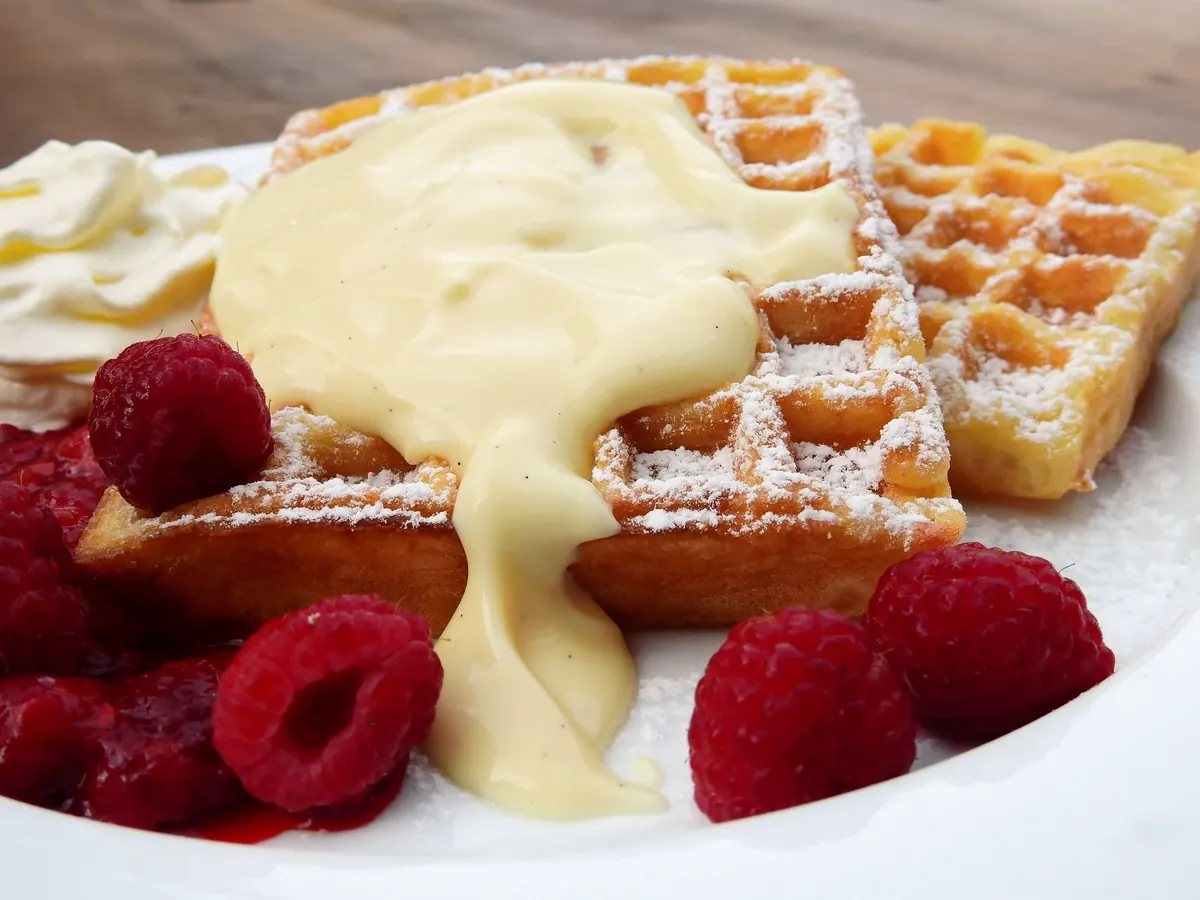
Set two bowls of pale yellow custard side by side and most people can't tell them apart. Both start with milk or cream, sugar, egg yolks, and vanilla, and both are cooked on the stovetop while you stir and watch the clock. The difference comes down to one ingredient: starch. Pastry cream has it, crème anglaise doesn't, and that single fact decides whether your custard sits in a neat piped ring inside a tart shell or pools in a glossy puddle under a spoonful of berries.
Pastry cream — crème pâtissière in French — is thickened with cornstarch, flour, or a combination of the two. You bring it to a boil, and the starch granules swell and set into a gel. That gel is why pastry cream can be spooned into a baked shell, smoothed flat, and sliced cleanly four hours later. The yolks add richness and color, but the starch does the structural work.
Crème anglaise has no starch at all. Its body comes entirely from egg yolks cooked gently until their proteins thicken the liquid just enough to coat the back of a spoon. Stop too early and it stays watery; push too far and you have sweet scrambled eggs. Done right, it pours like heavy cream and tastes like melted vanilla ice cream.
Here is the cleanest way to think about it. Pastry cream is a filling that happens to be a custard. Crème anglaise is a sauce that happens to be a custard.
Pastry cream is the workhorse. Because the starch sets into a firm gel, it can be spread, piped, layered, and sliced without running off the plate. It is also sturdy enough to be lightened: fold in whipped cream and you get crème légère, which is what you want inside a fruit tart where a dense layer would feel heavy. Beat in soft butter and you have crème mousseline, a richer filling for layer cakes.
Classic uses include fruit tarts and tartlets, éclairs and cream puffs, mille-feuille, Boston cream pie and doughnuts, and the filling for a French-style birthday cake.
Whisk the yolks, sugar, and starch together first, then temper them with a little hot milk before adding the rest. Return everything to the pan and whisk constantly over medium heat. Let it bubble for a full minute or two — this cooks out the raw starch taste and guarantees the gel sets. Undercooked pastry cream tastes like flour and stays loose.
Push the finished cream through a fine sieve if you see any lumps, then press plastic wrap directly onto the surface and chill. The wrap keeps a skin from forming. It keeps about three days in the refrigerator; stir it smooth with a whisk before using.
Crème anglaise is a finishing sauce. It is meant to be ladled around a slice of cake, poured over warm fruit, or used as the base for other desserts. Because it has no starch, it thickens only as far as the eggs allow — a light nappe that clings to the spoon but still flows.
Use a heavy saucepan and low-to-medium heat, and keep a spatula moving across the bottom of the pan constantly. Some cooks pull it off the heat around 180°F (82°C); others trust the spoon test — dip a wooden spoon in, draw a finger through the coating, and if the line stays clear, it's done. Strain it through a fine sieve no matter how careful you were. That step catches any stray bits of cooked egg and makes the texture silky.
If it does curdle, don't panic. Pull it off the heat immediately, whisk in a splash of cold cream, and strain. You'll usually save it.
Use pastry cream. A fruit tart needs a filling that stays put when you cut it and doesn't soak the crust. Spread the chilled cream into a blind-baked shell, arrange the fruit on top, and glaze. Crème anglaise would simply run out from under the fruit.
Pastry cream goes inside: between layers, piped into cream puffs, or spread under a ganache. Crème anglaise goes alongside — a warm pour at the table that turns a plain slice of sponge or pound cake into something plated. If you're serving angel food cake or a dense chocolate torte, a pitcher of chilled anglaise on the side is often the better move than any frosting.
This is where anglaise shines. Berries, stone fruit, and roasted or poached fruit all release juice, and a thin custard sauce mixes with that juice instead of fighting it. Pastry cream works with fruit too, but as a bed underneath it — a cushion in a tart shell, not a sauce over the top.
Sort of, with caveats. Thinning pastry cream with milk or cream gives you something pourable, but it will taste faintly starchy and won't have the clean dairy flavor of a true anglaise. Adding cornstarch to crème anglaise and boiling it will firm it into a pastry cream, but you'll need to recook it properly for the starch to activate. Both tricks work in a pinch; neither is quite as good as making the right one from the start.
Ask what the custard has to do. If it needs to stand, slice, or be piped, make pastry cream — cook it to a boil, chill it well, and keep it covered. If it needs to flow, coat, or pool on a plate, make crème anglaise — cook it gently, strain it, and serve it warm or cold.
One more practical note: both are egg-and-dairy custards, so cool them quickly, refrigerate them promptly, and plan to use them within about three days. Beyond that, texture and flavor both suffer. Make the one that matches the job, and the dessert mostly takes care of itself.
Photo: Pixabay / Pexels
St. Louis-style frozen custard is denser, richer and silkier than ice cream. Here is what defines it and how to make...
Learn the two cues that tell you a baked custard is done: the jiggle test at the center and an internal temperature...
Copyright © 2026 Custard Desk. All Right Reserved.